
Classic Brands - Changing Culture
By James Marcey - 28/08/2025 - 0 comments
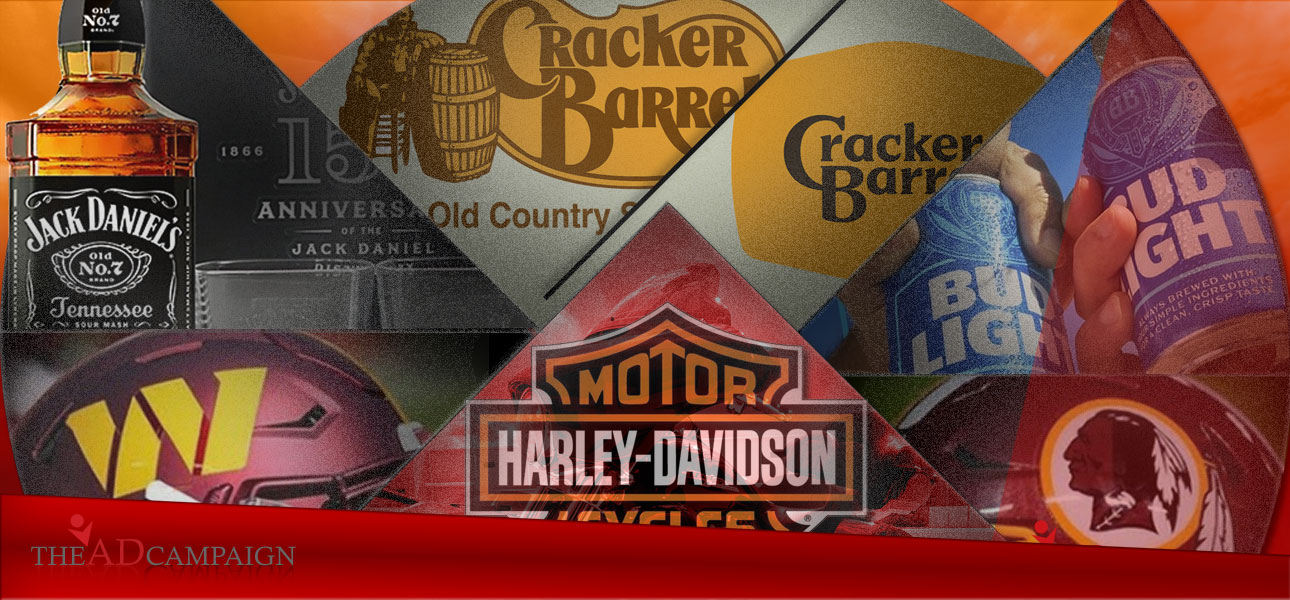
Wonderful… another think piece about Cracker Barrel going “woke.” Because clearly what America needs right now is one more hot take about hash browns, rainbow logos, and Harley-Davidson electric bikes. But hang tight—this one’s different. I’ve lived and breathed these brands for decades, and what’s happening to them says a lot about how boards, CEOs, and marketers are wrestling with culture in real time.
My Classic Go To Brands in a Changing Culture: The Push, Pull, and Price of Reinvention
Growing up just outside Washington, D.C., I was a die-hard Redskins fan since about 1965. I’m also part Cherokee, and I’ve long seen the name as a badge of honor. That personal lens matters because brand meaning is deeply tied to identity, tradition, and loyalty.
In full transparency, I also own two Harley-Davidson motorcycles, a passion that began in childhood. Any friend will tell you Jack Daniel’s has been my go-to drink for more than four decades. Bud Light has been diet beer since it launched in 1982, and my family regularly visits Cracker Barrel on road trips. These aren’t abstract “brands” to me—they’re part of my life.
That loyalty provides context for this analysis. Drawing on my background in branding, I’ll briefly examine how heritage brands have tried to reinvent themselves in line with shifting cultural and political trends, sometimes framed as “woke” marketing. We’ll look at strategic intent, social outcomes, the research (or lack thereof), and financial and shareholder impact.
The central question: Can a heritage brand drastically reshape its identity without alienating the very customers who built it?
The Strategic Intent: Why Change at All?
At the executive and board level, decisions to “modernize” or adopt socially progressive themes often stem from three motivations:
- Expanding Market Reach
Legacy brands worry about aging demographics and want to engage Gen Z and younger millennials who expect companies to take a stand on inclusion, diversity, and social responsibility. - Protecting Long-Term Relevance
Analysts and consultants warn boards that without aligning with cultural momentum, brands risk becoming relics tied to “outdated” values. - Talent and Investor Pressures
Employees and institutional investors increasingly demand that companies address ESG (Environmental, Social, Governance) and DEI (Diversity, Equity, Inclusion) criteria.
What that, let's look at a quick case study of what happened, and the outcome.
Case Studies
Washington Redskins → Commanders
Name retirement (2020) and full rebrand (2022) under sponsor/media pressure.
The Move
In 2020, under intense pressure from sponsors (FedEx, Nike, PepsiCo) and national media attention, the franchise retired the “Redskins” name after 87 years. They temporarily operated as the “Washington Football Team” before officially rebranding as the “Washington Commanders” in 2022.
The Good
- Removed a longstanding PR liability and aligned with corporate partners.
- Signaled inclusion and reduced reputational risk.
The Bad
- Fans felt tradition and identity were erased; polls showed up to 90% (including Native Americans) opposed the change.
- The new name was criticized as bland and uninspired.
- Merchandise sales spiked briefly but quickly cooled; emotional attachment lagged.
- Attendance momentum stayed weak amid ownership turmoil.
Current Context
- Still struggling with brand identity until their NFC Championship run in 2025 — their first since 1991.
- Polls show national support split: ~45% prefer “Redskins,” 35% “Commanders,” 20% undecided. In DC, negative views of “Commanders” dropped from 49% in 2024 to 34% in 2025.
Takeaway
The rebrand solved corporate and PR pressure but alienated loyal fans. A participatory, fan-first process could have modernized while honoring tradition.
Harley-Davidson
Shift from rebel heritage to lifestyle inclusivity, plus electrification investment.
The Move
Repositioned from freedom and grit to a more inclusive lifestyle brand, marketing to urban riders, women, and multicultural segments. Invested in electric motorcycles like LiveWire.
The Good
- Expanded appeal beyond middle-aged riders.
- EV investment positioned Harley for future-oriented customers.
The Bad
- Core riders felt abandoned; sales plateaued and dealerships closed.
- U.S. sales dropped by nearly 50%, along with the stock price over a few year period.
- Raised prices and created financing barriers to cover losses, making bikes less accessible, opening doors for BMW, Honda, and Indian.
Current Context
- Appointed Jochen Zeitz (ex-Puma CEO) in 2020 with a culture-first track record.
- Preparing another leadership change in 2024/25; rolled back DEI initiatives; stock value remains ~40% below pre-COVID levels.
Takeaway
Expansion diluted Harley’s story. EV could prove wise long-term, but reconnecting with the core remains critical.
Jack Daniel’s
Cultural campaigns and LGBTQ partnerships vs. traditional Tennessee heritage.
The Move
Highlighted inclusivity and modern celebrations, moving away from a masculine Southern whiskey aura.
The Good
- Earned praise for inclusivity.
- Expanded reach in urban markets where whiskey culture was evolving.
- Global scale buffered domestic controversies.
The Bad
- Traditionalists saw it as abandoning Tennessee roots (ironically, Jack is distilled in a dry county).
Current Context
- CEO Lawson Whiting has led since 2019.
- Family-controlled governance insulated Jack from shareholder pressure; leadership continuity prioritized stability.
Takeaway
Inclusivity wins clashed with heritage expectations. Global dominance cushioned fallout, but U.S. base tensions remain.
Bud Light
2023 influencer campaign aimed at inclusivity and younger demographics.
The Move
Partnered with influencer Dylan Mulvaney to signal inclusivity and reconnect with younger consumers.
The Good
- Tried to refresh relevance with Gen Z and younger millennials.
The Bad
- Triggered boycotts and media outrage.
- U.S. sales volume dropped ~25–30% and Anheuser-Busch lost billions in market cap.
- Disconnect between campaign symbol and blue-collar base amplified backlash.
Current Context
- CEO Brendan Whitworth remained; marketing VP Alissa Heinerscheid and her superior were sidelined.
- Board treated it as a marketing misstep, not a CEO failure; global ESG commitments continued.
Takeaway
The intent was clear, but weak testing and tone-deaf execution alienated Bud Light’s core, creating a cautionary tale.
Cracker Barrel
Menu and ambiance modernization collided with loyalist expectations.
The Move
Introduced plant-based menu items, Pride promotions, and replaced historic memorabilia with modern décor.
The Good
- Diversified menu for younger, health-conscious diners.
- Aligned with DEI initiatives and attempted to modernize brand relevance.
The Bad
- Loyal customers saw the changes as abandoning tradition.
- Presentation inflamed controversy; social media backlash overshadowed product benefits.
Current Context
- Julie Felss Masino (ex-Taco Bell Intl.) became CEO in 2023 to accelerate modernization.
- Board prioritized faster change, but the backlash showed risks of outpacing the base.
Takeaway
Product innovation was sensible, but rollout tone and loss of heritage feel alienated the base.
Research vs. Reality
Most of these campaigns were driven by top-down leadership decisions influenced by consultants, agencies, and internal DEI/ESG mandates. What was missing in several cases:
- Deep customer ethnography. Who actually buys Bud Light, rides a Harley, dines at Cracker Barrel — or cheers for the Washington Redskins? What values do these communities hold, and how tightly is brand identity tied to tradition?
- Scenario testing. Few campaigns tested backlash risk outside of focus groups, and in Washington’s case, fan sentiment research was eclipsed by sponsor pressure from FedEx, Nike, and others.
- Board pressure. CEOs increasingly recruited for their ESG orientation or willingness to lead cultural change — sometimes over pure product/brand stewardship. The Commanders’ rebrand was less about fan-driven evolution and more about corporate risk mitigation irregardless of the fan numbers.
Measuring Outcomes
- Sales & Market Value: Bud Light lost ~25–30% of U.S. sales post-controversy. Harley’s U.S. ridership declined nearly 50%, with LiveWire gaining headlines but not traction. Cracker Barrel’s stock dipped after its Pride menu push. Jack Daniel’s weathered criticism but avoided major losses due to global diversification. Washington saw a brief spike in merchandise sales after the name change, but long-term fan attachment weakened, and game attendance remained stagnant.
- Brand Equity: Each brand faced polarized perception. Gains with one demographic coincided with louder losses among another. For the Commanders, the shift won corporate approval but left a fractured fan identity and ongoing debates over authenticity.
- PR vs. Profit: Media coverage amplified these controversies far beyond their original campaigns. In many cases — Bud Light’s influencer partnership, Harley’s DEI push, Cracker Barrel’s Pride rollout, and the Redskins’ rebrand — negative press outweighed the intended goodwill.
Were CEOs Hired for This?
In today’s corporate landscape, boards are placing increasing weight on ESG (Environmental, Social, Governance) priorities and cultural relevance when selecting CEOs. While not every leader is brought in explicitly to drive social change, many executives interpret their mandate as one of modernization — reshaping the brand narrative to resonate with younger generations and evolving social values. This approach has divided shareholders: some embrace it as necessary for long-term relevance, while others see it as straying from the company’s core mission and alienating loyal customers.
Corporate governance, particularly among publicly traded companies, has shifted away from viewing CEOs solely as operational leaders focused on growth, supply chain, and finance. Instead, boards now expect them to act as cultural stewards, capable of navigating ESG pressures from institutional investors like BlackRock or Vanguard, signaling alignment with younger employees and consumers, and balancing short-term profitability with long-term “brand purpose.” The result is that many CEOs see redefining their company’s cultural footprint as part of their job description — even when the existing customer base has not asked for such changes.
Synthesis: Leadership and Accountability
Harley-Davidson has repeatedly sought leaders with a clear cultural-change mandate, most notably Jochen Zeitz and now again with new leadership. Bud Light’s parent company, AB InBev, chose to protect its CEO in the wake of controversy but shifted accountability onto mid-level marketing executives, removing them to restore stability. Jack Daniel’s and its parent, Brown-Forman, by contrast, remained steady under family-controlled governance, prioritizing continuity over disruption. Cracker Barrel explicitly brought in a CEO with a modernization track record, only to walk directly into backlash as the brand’s efforts clashed with its traditional customer base. The Washington Commanders, meanwhile, executed one of the most dramatic brand shifts in U.S. sports, abandoning the Redskins identity under heavy sponsor and boardroom pressure. While ownership eventually changed hands, the decision was driven more by risk mitigation than fan-first leadership, leaving the team struggling to rebuild cultural equity and reconnect with its base.
This raises a critical question for corporate boards: are these leaders being hired to steward and preserve classic brands, or to engineer cultural reinvention? The answer differs by company, but the overall trend is clear: boards increasingly equate “future relevance” with cultural repositioning — even when the data suggests such moves risk alienating the very customers who have long sustained these legacy brands.
Final Analysis
Pros of Repositioning
- Opens potential markets among younger and more diverse consumers
- Signals modernity and cultural relevance
- Appeals to employees and institutional investors focused on ESG
Cons
- Risks alienating the loyal customer base
- Backlash amplified in hyper-polarized media landscape
- Sales and stock hits can outweigh goodwill gains
- Distracts from core product and heritage storytelling
Conclusion
For heritage brands, the lesson is not that change itself is bad — but that change without deep audience understanding is dangerous. Aligning with cultural shifts can succeed when it feels authentic to the brand’s DNA, such as Harley investing in electric motorcycles while still celebrating the open road. When repositioning looks opportunistic or dismissive of loyal customers, backlash is almost inevitable. Boards and CEOs must ask: is this a bold reinvention of our brand story, or a cultural play to satisfy those who never bought from us in the first place? The answer often determines whether it’s remembered as progress or as miscalculation.
From my own career in branding, the constant challenge is balancing growth opportunities with the risk of alienating core customers. Legacy brands shouldn’t feel compelled to bend to every social or cultural shift. Consumer diversity is a strength — people think, shop, and find fulfillment in different ways. Brands that focus on their core audience often build stronger loyalty while leaving room for competitors to serve other markets. Those who try to be everything to everyone risk diluting their value, much like the “Amazon/Walmart effect,” where scale comes at the cost of authenticity and differentiation.
Comments
Write a comment